"It never gets easier, you just go faster." - Greg Lemond
Showing posts with label Outsole. Show all posts

Monday, June 24, 2013

Review of Salomon Sense Ultra

I've had the pleasure of tooling around in a pair of Salomon Sense Ultra's for several months now.  The short review is that they are a tremendous lightweight shoe with decent protection and decent durability.

First, I have to say that in general, all the lives of my shoes are dramatically reduced now that I'm running in Colorado.  But it seems the Sense Ultra is particularity susceptible to dying quicker in the Rocky Mountains. Its a sacrifice one has to make for a lightweight shoe I guess.  I wouldn't mind seeing a little more outsole on these guys.

I ran quite a bit in the original Sense, but it was never quite comfortable enough for me.  I'm not sure what it was.  I would get blisters on the outside of my pinky toes on both feet and never could lock the heel down quite good enough.  When I was at 3-Rivers Running Company, I had the chance to look at the Sense Ultras.  I thought the toebox looked a little wider, and the heel cup was slightly different, in so much as it seemed to offer a greater hook to come up over the back of the heel.

I actually decided to size down to a 10.5 from my typical size 11 (MT110, Speedcross 3, Pearl Izumi Trail N1) and the shoes fit nearly perfectly for most of their lifespan.  I have concluded that the heel cup is better and the Ultras either have a wider toebox or it is easier to stretch it out over the life of the shoe.  They accommodated my feet, which tend to be on the wide side, very nicely.

Grand Canyon R2R2R
I've put these shoes through hell.  I ran several long Poto runs back in Michigan in them.  After that they still looked like new, maybe with a little bit of midsole wrinkling, which didn't seem to influence the cushion.  Then I went to Colorado for a job interview and starting running in the Front Range  in the Sense Ultras.  Then I took them to the Grand Canyon for a R2R2R.  Then back to Colorado for more Front Range running.

I've taken them through numerous water crossings, both deep and shallow, and the shoes drained and dried out very well, which is perhaps unsurprising.  The low profile nature of the shoes also allowed them to handle well in the river when you aren't quite sure what you're stepping on.

I found the outsole to be plenty sticky on most rocks, as long as they weren't too wet and grimy (the rocks not the shoes).

Protection in someplace like Michigan is fantastic.  Protection in Colorado is decent.  Forefoot/midfoot is usually protected enough that you even if you catch a stinger, the pain is fleeting and doesn't last long. It seems Salomons special carbon fiber rockplate does its job.  I did notice that if I stepped on a narrow or sharp rock in the arch area of my foot it would be quite painful.   I attribute this to the flexibility of the shoe.  Its nice for running fast to have a flexible shoe, but it does allow for the occasional painful reminder that these shoes are intended to be a racing flat.

My longest run in them was the R2R2R at the Grand Canyon, which was 48 miles and I probably had the shoes on my feet for 13+ hours.  No blisters, which is great and I'm sure I wouldn't have had such luck with the regular Sense.

After about 300 miles now, the shoes are totally toast.  At least in my terms.

Missing lugs and outsole

After about 200 miles the tread started wearing down and lugs were shredded off.  I continued to abuse them, doing a Hope Pass double crossing and summiting a 14'er in them.  Now, there are several spots where the glue seems to have failed and I can peel back the outsole to expose more midsole.  In other places the outsole just appears to be gone.  One of the great things though is that the protection never failed on these shoes.  The rockplate is still in great shape, despite numerous attempts to puncture it by sharp rocks.  Kudos to Salomon.

Still not destroyed


Despite the wear on the outsole, I can probably get a few more miles out of these guys.  I feel that the traction is starting to be reduced, but really they never had tremendous traction in the first place.  Speaking of traction, the rubber is decently sticky, but they're no La Sportiva.  The shoes have a great ride on hard pack trail, fireroads, and pavement.  The small footprint allows them to be very maneuverable.  Unfortunately I found them to be VERY skatey in loose dirt/gravel on switchbacks and in the mud.
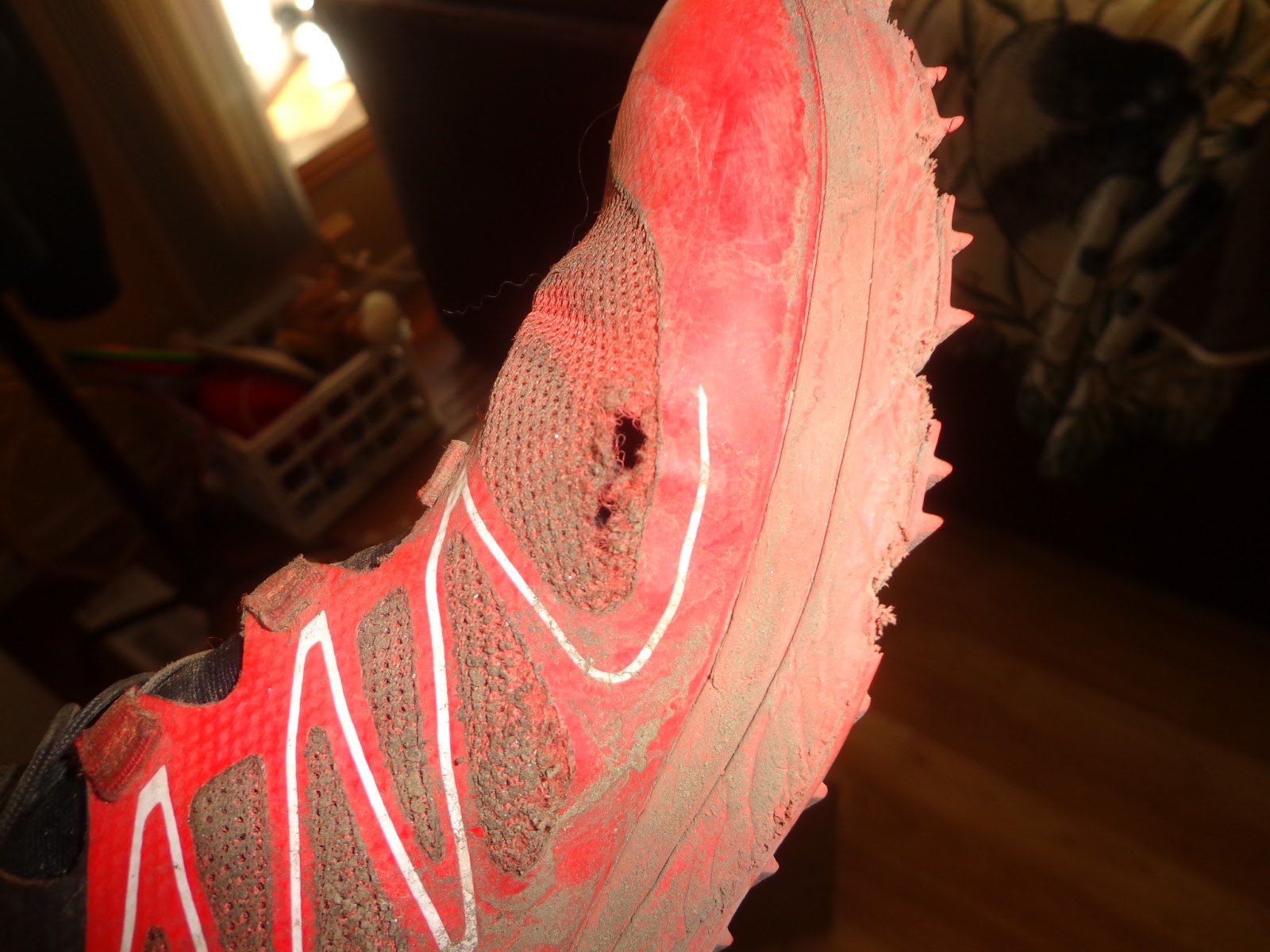
Holes in the medial sides of both pairs

Another hole forming on the lateral sides

The upper is probably the biggest issue with these guys right now.  I'm not worried about them ripping and becoming "unusable" during a run, but they have developed holes in the medial side of the toebox.  Now they let in a ton of dust and gravel.  Otherwise the mesh upper and Sensi-fit sock/sleeve thing was amazing.

Now I just need to save up enough $ to get another pair, or wait for a new iteration of these shoes.  I've noticed a few pictures from Zegama where it looked like the Salomon team had a pair of Sense Softgrounds!  When can I get these!  I think they will probably be a slight bit heavier, but the added weight for what I can only imagine is a more durable outsole with better traction would be a no brainer for me.  I just love the fit of the Sense Ultra so much, that a shoe with a more rugged outsole sounds like a great combo.

Looks a lot like the Speedcross outsole (Photo by Ian Corless)

Niice!  (Photo by Ian Corless)

Overall, the Sense Ultra is a great shoe.  Excellent fit.  A shoe that makes you want to run fast.  Protective for how lightweight.  Very maneuverable with their low profile/small footprint.  The cushion does its job even though it tends to wrinkle quickly.  The biggest downsides are the poor traction on anything that is loose or muddy as well as the relatively short lifespan.  Oh and they are so freaking expensive.  I should mention though that I've heard through the grapevine that Salomon plans on progressively lowering the price over the next couple years.

Monday, April 8, 2013

Hoka Bondi B 2 Review

By Guest Reviewer Jason Robertson

Jason's review of the Hoka Stinson Evo Low was so popular that when he bought a pair of the new Bondi 2's I pestered him for a review until he finally agreed.  Enjoy!


My Recent History with the Hokas:
     Last June I picked up a pair of Hoka One One Stinson Evo B Lows.  In my review I raved about their downhill prowess, sticky rubber traction, and the polished fit and feel.  I also questioned the outsole longevity and how would running in such a pillowy-soft shoe effect the training adaptations typically received in lower, less cushioned, more flexible shoes.
     The summer is my high volume time of the year as I am not teaching.  So I ran.  Mixing the New Balance 110’s, Brooks Pure Grit, and the Hoka Stinson B’s; I averaged 85 miles per week.  The Hokas were my long run shoe of choice.  I continued this until the peak phase for the Hell 50k in September.  I ran the Woodstock 50K and two weeks later I raced and won the Hell 50k.  I did both races in the NB 110’s.  After Hell, my hip was incredibly sore and I took October off.  During this time the Hokas became suspect to the hip injury and I shelved them.
     During November and throughout the winter months I tried several new shoes and started to mix the Hokas back in.  My hip healed up after some much needed cross-training and yoga sessions.  Finally, in February, I was 18 miles into a road run wearing the Altra Instincts.  My left calf felt as if someone had snuck up and stabbed it with a knife.  I immediately called my wife and she graciously picked me up.  Throughout the next two months I tried every shoe, stretch, and rehab technique in my inventory and nothing seemed to help.  The calf would seem ok, then boom! Injury and back to square one.  I pulled out of the 100 miler I was signed up for, but I had this awesome trip planned to the Smokey Mountains.  I utilized Running Warehouse’s return policy, sending back the Altras (both the Instincts and Superiors) and had them send me a pair of the new Hoka Bondi B 2s.


Hoka Bondi B’s
     These shoes allowed me not only to enjoy the trip, but to run much more than initially expected.  I started very cautiously, hiking the ups and jogging on the downs (there’s not much in between).  Then, toward the end of our first outing I was able to run the downhill and feel zero pain in the calf.  The next day, I ran everything that my current state of fitness would allow and no pain.  I commented to Jon several times how good these shoes felt and how good my calf was doing.  Third day, besides crossing an icy river of death, all was well.  On the fourth, I switched to the Brooks Cascadia because of some preconceived notions of mud in the upper elevations needing increased traction.  My calf spoke to me all day.  I still have no idea why the calf is good in the Bondi B’s and nothing else, but I’ll take it.  Here’s my take on the shoe

The author horsing around in his Hoka Bondi B 2's

Fit and Feel:
     The Bondi’s have a great upper.  Very thin mesh on the outer, a hexagonal structured material and then a final mesh that sits against your sock that is very comfortable.  I had over seven hours and never felt a hot spot or uneasy rubbing.  The shoe runs true to size, if not a touch over-sized.  I wear 10’s in the NB 110’s and bought a size 10 Bondi.  I could probably go for a 9.5, but with long races and foot swelling, the 10’s will be just fine.  My first run in the Stinsons did develop some chaffing around my pinky toe area.  I had nothing with the Bondi.  From the first run until now, no blister or hot spots; these uppers are top-notch.  One of our shorter outings, a 3.5 hour, had a stream crossing right off the bat.  Feet were wet the entire time and no issues. They are not over-built, but do offer enough structure for technical trail use.
     As good as the uppers feel, there does seem to be a weak spot.  I now have well over 50 hours in the Bondi.  After yesterdays trail marathon the upper around the toe box was stressed to the point that some holes were forming in the first layer of mesh.  These had not formed until yesterday and the race took place on a mountain bike course with many tight, twisty switchbacks.  I wasn’t too surprised by this and it confirmed the major weakness of this shoe.
Slight wear on both sides of the toe box

Not a Shoe with the Quickness:
     This is the major drawback with the Bondi, in my opinion.  You just don’t get a high turn-over or quick turning manners from this shoe. Think slow(er) and methodical versus light and racey.
On the first major downhill, heading back to Laurel Falls the trail was strewn about with a lot of technical debris: rocks, roots, mud, tight-twisty turns, and off cambers; I thought I was flying.  Jon came up and let me know that our 9 minute per mile pace was ok, but went shooting by in his Senses (half the weight, half the mid-sole, much higher turn-over).  I just didn’t feel safe following.  I felt very protected and could’ve ran that pace over that terrain all day, but just didn’t feel like I could handle all the technicalities any faster.  Yesterday’s trail marathon was on much smoother terrain where I could really fly on the downs, but the tight-twisties forced me to slow slightly.  
     Safety on the down hills is also where this shoe seems to shine over the Stinson.  I never felt my ankle twist or have any major deflection on the loose rock as I did with the Stinson B’s.  This did give me more confidence going into loose rock piles and slick roots.  In my opinion, I think the Bondi does a better job of absorbing the side-load impacts than does the Stinson; most likely because of mid-sole design.
Outsole design:
     Super tacky! As good as the Stinson B’s outsole and the quality of the rubber for trail use is, the Bondi trumps it.  As mentioned before, I wore the Cascadias on our last outing because we thought it would be incredibly muddy with all the snow melt.  I didn’t notice much of a difference in traction levels and was left wanting the plushness and calf soothing feel of the Bondi. Anything but algae covered river rock is traction for the Bondi.  Back in Fort Wayne this week, we had a few days of sloppy, snotty mud and while there was some slippage, I was happy with the way that this road shoe handled the mud.  Hoka could make a very nice winter running trail shoe simply by adding lugs to the rubber portions of this shoe- good stuff.
Outsoles after about 50 hours


Conclusions
The Goods:
1. Great fit and feel, the upper and sizing are spot on. All day comfort, lace ‘em up and forget.
2. Protection and midsole shape.  Inspires confidence and great for injury prone runners and recovery days.
3. Awesome outsole, holds on to multiple surfaces even though it’s marketed as a road shoe.

The Bads:
1. While very comfortable the upper is weak in some spots
2. Not a fast turner or allows for high turn-over as other lighter shoes do (12oz on the food scale)

All in all, these are allowing me to run and get back to a normal training schedule.  If you’re in the Hoka market, I would definitely look at, and try on a pair of the new Bondi B’s.  They are very useful for trail applications, high mileage outings on road, trail, mountains, ect. If you’re racing 50 miles or more, these would be great in a drop bag- the longer the race/outing the better they feel. 
  

Sunday, January 20, 2013

Review of the La Sportiva Helios

Review of the Helios and a comparison to the Vertical K


I was a huge fan of the La Sportiva Vertical K, I was excited when I saw that the Helios was a similar shoe, but built with longer distances in mind.  Unfortunately, I don't wear my Vertical K's much anymore, as they either shrunk, or my feet grew, and all of a sudden they're too small.  I made sure to size up when ordering the Helios.

Usually I wear between an 11 and 11.5.  I have a pair of Vertical K's that are 45.0 - they're too small.  So I went with a 45.5 when I ordered the Helios, and they are just right, although if I wanted to wear big socks (Drymax Maxpro or Trail) I might find myself a little constricted.  I hope that helps anyone trying to figure out what size Helios to buy.

Helios foreground, Vertical K background

First Impressions
The Helios is heavier than the Vertical K.  I noticed it as soon as I took them out of the box.  I assume this is mostly due to the 2mm rockplate/eva layer that was added to the shoe in order to provide a little bit more protection.  La Sportiva also made some modifications to the upper.  Gone is the one-piece upper with built in scree guard.  Instead, La Sportiva has used a new "air mesh" upper, which I have to say is incredibly comfortable, although it doesn't look as sturdy as the scree guard upper.  


I've run about 100 miles in the Helios in the last 3 weeks, so I feel comfortable reviewing them.  I haven't noticed any hotspots or problems, which is a great start.  The local trails have oscillated between frozen mud and mucky mud, and the Helios handle both well.  

Upper
Speaking of the upper; the lacing system is much more traditional than most other La Sportiva shoes. Relatively thick laces with normal anchors provides a more customizable fit than can be achieved with laces that are hidden under a scree guard.  Also, a big bonus is the extra eyelet that can be used to tie the shoes in an ankle-lock down fashion, something I thought the Vertical K really would have benefited from.  While the Helios does not have a scree guard style upper, the tongue is gusseted, and I haven't noticed any problems when running through sand, so I'd say it works well.  The shoe also breathes very well with the air mesh that is used for the top of the upper.  I'm not big on sockless running, but even if I was, I don't think the Helios is built for it, there are exposed seems in several places.

The last difference in the upper between the Vertical K and the Helios is the overall stability provided by the upper.  The Helios has a substantial heel counter that probably adds a little weight, as well as thermoplastic overlays that are used to help secure the midfoot.  There has also been the addition of a pulltab on the heel of the Helios, which helps get them on and off quickly.

Gusseted Tongue


Thermoplastic overlays to secure the midfoot


Midsole/outsole
Morphodynamic.  Pretty sweet.  Light and cushioned.  Actually, the Helios feels a little firmer than the Vertical K does.  I am not sure if this is due to the rockplate or whether it is because they used a midsole foam with a higher density.  Along with the slighter firmer ride is perhaps a lesser degree of flexibility.  Don't get me wrong, the wave pattern still allows for good flexibility, but it is not quite as slipper-like as the Vertical K.  I also feel like the back heel of the helios is not quite as cut-out as the Vertical K.  This might be why runningwarehouse spec's the Helios as a 5mm drop and the Vertical K as a 4mm drop.  I agree, the Helios feels not quite as minimal in general as the Vertical K.  This could be good or bad, depends on your preferences and the type of race you're running.  I should also mention that both shoes use a sticky Sportiva (FriXion AT) rubber that seems to wear pretty well.

Pretty similar outsole?

Morphodynamic in both

Conclusions/overall feeling
I think the Helios is very much what I expected.  A more robust version of the Vertical K.  The protection on gravel roads and local trails seems pretty good, although its hard to test them fully without making a trip to somewhere rockier.  The overall fit is excellent, the Helios feels wider in the toe-box than the Vertical K, and less pointed up towards the toes.  At first I was a tad disappointed by the fact that the Helios felt firmer than the Vertical K, but I adjusted pretty quickly, and now enjoy the energy transfer that a slightly firmer midsole allows.  Overall, I rate this shoe very highly.  Excellent fit, good traction, adequate protection and cushion, low drop, and fairly lightweight (8.5oz size 9 men's).  I think anyone who likes the Vertical K, but wants a little bit more for longer runs would find the Helios to be a nice compromise.  Also I think someone looking to step down from more traditional shoes would find this is a nice intermediate shoe that combines lightweight with moderate drop, and makes for an aggressive and comfortable ride.  I don't mind a little extra weight on my shoes when I feel it is put used for practical purposes, and I think that the extra 1.5-2oz on the Helios serves a purpose, making them a well-rounded trail shoe.

Are they built for Ultras?  Yes, I think so, but to be honest I haven't run more than 15 miles in them yet.  Its winter, give me some time and I'll try to get a few longer runs in.  The roomy toe box and extra protection really make them a nice shoe, def my favorite La Sportiva offering in a long time.

Toecaps

With insoles removed

My friend Mark just ran the 2013 Rocky Raccoon in his Helios, here is what he had to say about them:  " I wore these for 100 miles at Rocky Raccoon over the weekend. It was a drier year than last, and then the challenge is the dust and sand that often gets into the shoes and grinds away at your feet. The Vertical K's have the gaiter built in, but the Helios does it a little different. The real question to me was, does the Helios work. In a word, yes. I changed socks at about mile 72, due to a blister forming on the outside of my little toe. There was no sand or anything else to be removed from my shoes the, and the same was true at the end. I wore them for the full 100 miles, and I never regretted the choice. I kicked a number of roots, but none of them bothered my toes a bit-- though there was a little loss of blood involved. The Helios fine mesh must be an adequate virtual gaiter, and they seem to give me more support than the Vertical K for the long run."

Tuesday, December 4, 2012

Asics Gel Fuji Trainer 2 Review

I was very impressed by the Gel Fuji Racer, which caused me to be quite optimistic about the new Gel Fuji Trainer 2, a midweight trail shoe from Asics that fits into the Gel Fuji line of shoes.

The geometry of this shoe is quite appealing to me.  A decent stack height with the forefoot being spec'd at 19mm and the heel at 25mm.  Overall, creating a 6mm heel to toe drop.  Furthermore, the lugging pattern looked much more aggressive than the Gel Fuji Racer, and the weight wasn't too crazy (under 10oz)


Fit
I ordered a size 11.5, which seems to be the typical size I order these days.  It is also the size I wear for the Gel Fuji Racer, and lengthwise I would say these shoes are very comparable in fit, and just right for me.  However, the Fuji Trainer 2 feels much wider throughout the midfoot and maybe a touch wider in the forefoot, something I found a little disappointing.  I should mention, I hated the skinny black laces that came with the shoes and swapped them out for a pair of old MT100 laces.

While most Asics shoes fit my feet like a glove, with a nicely tight midfoot wrap, the Fuji Trainers felt loose and baggy.  Combine this with the fact that the lacing system is a little unique (and strange), I have found it hard to really get these shoes to be tight enough without cutting off circulation to my feet.  I think this is magnified by the fact that there is not a traditional lowset eyelet and the end of the eyelets, which usually allows for the lockdown style of lacing.  Honestly, the little cloth lacing eyelet seemed kinda useless and stupid.  Thinking about it harder, I think because of the wide base of the shoe, the overlays aren't as useful as the typical Asics overlays; maybe if my feet were a little bit higher volume this wouldn't be a problem.
No eyelet for ankle lockdown lacing
Very roomy around the ankle (a little too much) (ignore the saucony insole)

Careful study of the shoes has led me to conclude that the entire area from the tongue to the heel collar is very large and open, thus if you have somewhat skinny bony ankles like myself, there is a lot of room for your feet to move around.  I am unable to get my heel to lock down even though the length of the shoe is perfect.  It hasn't caused me too much grief, except for the fact that debris enter the shoe a little too easily.  Also, there is a perforated, removable insole, which I swapped out for my favorite Kinvara insoles.

Traction
Traction on these shoes is pretty awesome.  The lugs do exactly what you'd expect.  Combine this with a full contact outsole and a wide platform and I found that they bite into just about any type of trail I have available to test them on.  The wide platform really helps give the foot a stable landing pad when running through sandy sections of trail.  The lugging almost reminds me of the Speedcross, except they aren't quite as tall.
Lug height isn't crazy, but its enough

However, towards the heel, Asics implemented a series of offset square lugs rather than the winged lug pattern found on the rest of the shoe.  I think this is to help de-couple the heel if you're a heel striker, but what I have found is that these guys really suck up mud and don't shed it well.  I've ended up with clumps of my stuck only to my heels on several wet runs.

Mud sticks to the heels a little bit
Ride
Along with the traction, the ride and underfoot feel of the Fuji Trainer 2 is probably my favorite aspect.  They are protective without being sluggish, firm without being too solid, and the 6mm drop really feels smooth when running fast or slow.  There is no rockplate, but the foam is fairly firm and I haven't noticed any problems when running across gravel on dirt roads (my nemesis).  They are moderately flexible, but nothing compared to the Fuji Racer.  I have about 150 miles on my pair, and when I definitely feel as though they have been getting a little more flexible as I break them in.  I have noticed that when running across road or very firm trail, the lugs seem to add more cushion, but also a slightly unstable feeling.  It is nothing series, but I just thought I should mention it.

Conclusions
As of right now, I like this shoe, but its not quite what I was expecting.  The fit and lacing issue is a big disappointment on what otherwise is a very solid offering from Asics.  If you have wide feet, high volume feet, I could see this being a great shoe.  I have since tried to add an eyelet of my own in order to help secure my heel, and it has helped, but for some reason I can't help but think Asics could have done a better job of this than I did.
Added my own eyelet

Because of the traction, relatively low weight, and the comfortable, protective ride, I can see these shoes being a great choice for a long race such as a 50 or 100, especially one that has mixed terrain.  If these fit your feet properly, I think they would be an amazing shoe.  I still enjoy mine, even though I can get irritated that with the roomy feel.  I just wouldn't expect them to fit like a pair of Fuji Racers.

Questions?  Comments?  If there is anything I haven't covered, or if you have experience with these shoes, please leave a comment to help anyone else out there, looking for...  The Perfect Shoe.


Monday, July 16, 2012

Hoka One One Stinson B Evo Low Review

By Jason Robertson

I had been considering getting a pair of Hokas.  While I couldn't find the correct size, Jason (who is also a shoe nerd) picked up a pair of the new Stinson B Evos, and I begged him for a review.  Enjoy!
Get the name right damnit!  Minimalist shoe label from the running store.


Fit
A little narrow in the toe box.  My left foot is larger than my right and pinky toe was slightly rubbing.  I was able to change out the standard-sized, left insole for the thinner one provided-no more rubbing and nice customization.  This was the only concern I had with the fit of this shoe.  The upper has great lock-down and provides day-long comfort.  It also has a taller (more volume) and slightly more narrow fit than, say, a MT110 or the Brooks Pure Grit.  I run a size 10 in those models and have found the 10.5 in Hokas very nice, in addition to the thinner insole in my left shoe.
Accessories:  Extra insoles and laces

Traction
Traction rocks on this shoe.  You can hear it grip on pavement and the dry hard pack we’ve experienced here in Northeast Indiana this summer.  It does lack the deep lugs of a Salomon Speedcross, but I’d say the rubber is on par with the MT110 for tackiness. I felt very secure on wet, downhill corners during my outings in the Smokies and no problems on wet rock (the Brooks Pure Grit really let me down on the slick rock during our last trip so I was very cautious and was pleasantly surprised with the Stinson B Evo).  This outsole also receives high marks for self-cleaning action.
Wear resistant, very tacky Hoka outsole, very nice!

Cushion

Goes without saying…this shoe has lots of cush.  Confidence inspiring, feels like cheating, unfair advantage cush.  This shoe has allowed me, over the past month, to become a downhill bomber.   I’ve also, at the same time, been able to handle an increase in mileage as I’ve had time off from work this summer.  My legs have not had that “beat down” feeling they usually receive from such an increase into the 100 mile per week range. 

Some might say, and mentioned by Marshall Ulrich in his review of Hokas, that having so much cushion could prevent or hinder the gains (i.e. muscle breakdown-healing, ligament, joint, tendon strengthening/changing) of running in a more minimally cushioned shoe.  I do wear and run in the Minimus 00, Kinvara and the Pure Grit a few times each week and know there is benefit in low slung shoes.  I recovered from an injury 2 years ago through a process of running barefoot and utilizing minimal shoes.  Not having a serious injury since, I want to maintain my form.  The Hokas have allowed for more vigorous miles to be put in each week and I believe they have allowed some strengthening in areas that lesser cushioned shoe might not.  For instance, pounding the down hills helped strengthen my quads.  I also noticed my ankles feeling a bit worked-similar to when I do barefoot speed work on the soccer fields.  The Hokas also allow for the same cadence and running stance that I have developed with my other lower shoes.  It is interesting to note that Playmakers have a minimalist label on the box as seen in my first picture.

Lots of cushion in these bad boys
Protection
Search out the sharpest stingers on the trail.  Nothing short of a 3” nail will hurt your foot.  I totally understand why Darcy Africa (a PI sponsored runner) would opt for the Hokas at Hard Rock, even when she has Isoseeks at her disposal.  4-4.5 hour run/hikes in the Smokies had my feet begging for more. Usually after the four hour mark of running trail, especially in the Smoky Mountains, my feet start letting me know that they’re feeling the rocks, roots and uneven terrain. No matter what I stepped on, I felt no pain.  I am very excited to try these out in some fall 50 milers and next year’s mountain 100’s.
Flexibility
Next to none.  This did make my left arch sing a little (same tightness I had with the MT100/101s).  After some foam rolling on the calf, all was well.  With such a well cushioned midsole, the Hoka is a stiff shoe.  You can’t roll it up like a Nike Free.  This is just fine with me.  The stiffness actually inspires quite a bit of confidence when rolling fast on the downs and the rockered shape of the shoe allows for a nice seamless foot strike to toe off.

Likes
·        Awesome cushion and protection.  I will never again have to choose what shoe I’ll wear on a run over 3 hours…or question whether or not to bomb a downhill.
·        Great drainage.  After the several crossings we did in the Smokies, I was very impressed.  This shoe, surprisingly, drained and dried as well as a pair of 101s, which in my opinion; earned the title for the quickest drain/dry shoe.
·        Nice alternate insole/lacing options (comes with quick lace intact-laces optional, but you have to cut the quick lace in order to remove).
·        Overall fit and wear.  I plan on wearing this shoe through next summer and have no concerns about this shoes making it to 1,500 miles-seems very durable at this point. Also, the fit and drop of the shoe does not interfere with wearing my other shoes.  I simply throw on the extra cushion, no worries about a large ramp angle when switching to a more cushioned shoe. 
Dislikes
·        Weight claims.  I read from several sources that these shoes weighed in anywhere between 9 and 10.5 ounces for a men’s size 9.  The shoes I purchased, a size 10.5, weighed in at 13 1/8 ounces on my extremely accurate food scale.  This is about the weight of a pair of Cascadia 6s in the same size.  Interestingly enough, I planned to buy a pair of Cascadia 7s.  I tried on the Hokas 1st, ran around the store, ran a 5k with Scott Jurek(! Stopped in on his book tour) in a trial pair then tried on the Cascadias.  They felt very flat and unresponsive comparatively.  I dropped the extra $60 for the Hokas. 
          The Hokas do a good job of feeling lighter than they really are.  Just        looking at them, you would think they are heavy clodders.  Upon picking        them up they feel uber light.  Same thing happens when running in      them.  They have such a good bounce and energy return, that they seem          to shrug off some ounces and feel about the same weight as a pair of Pure Grits.
·        Cost.  These are the most expensive in my shoe quiver and gave me the most wife feedback.  But, if they last as long as I think, cost will be a mute point.  Plus, they do come with extra laces and another set of insoles allowing a more customizable fit.


Writer Bio
 
My name is Jason Robertson (33 years old).  I’ve been married for 15 years, have 3 kids and teach middle school Language Arts.
I grew up riding/racing dirt bikes and fell in love with running in ’09 after finally getting the right pair of shoes on my feet, ridding myself of shin splints, and completing my first 50k. 

Jason why so modest?  Jason has run over 20 Ultras, including 3 100 mile races.  Always up for a long run,  he is a constant source of inspiration and enthusiasm.